Yonsei Godeok S Orthodontics Clinic
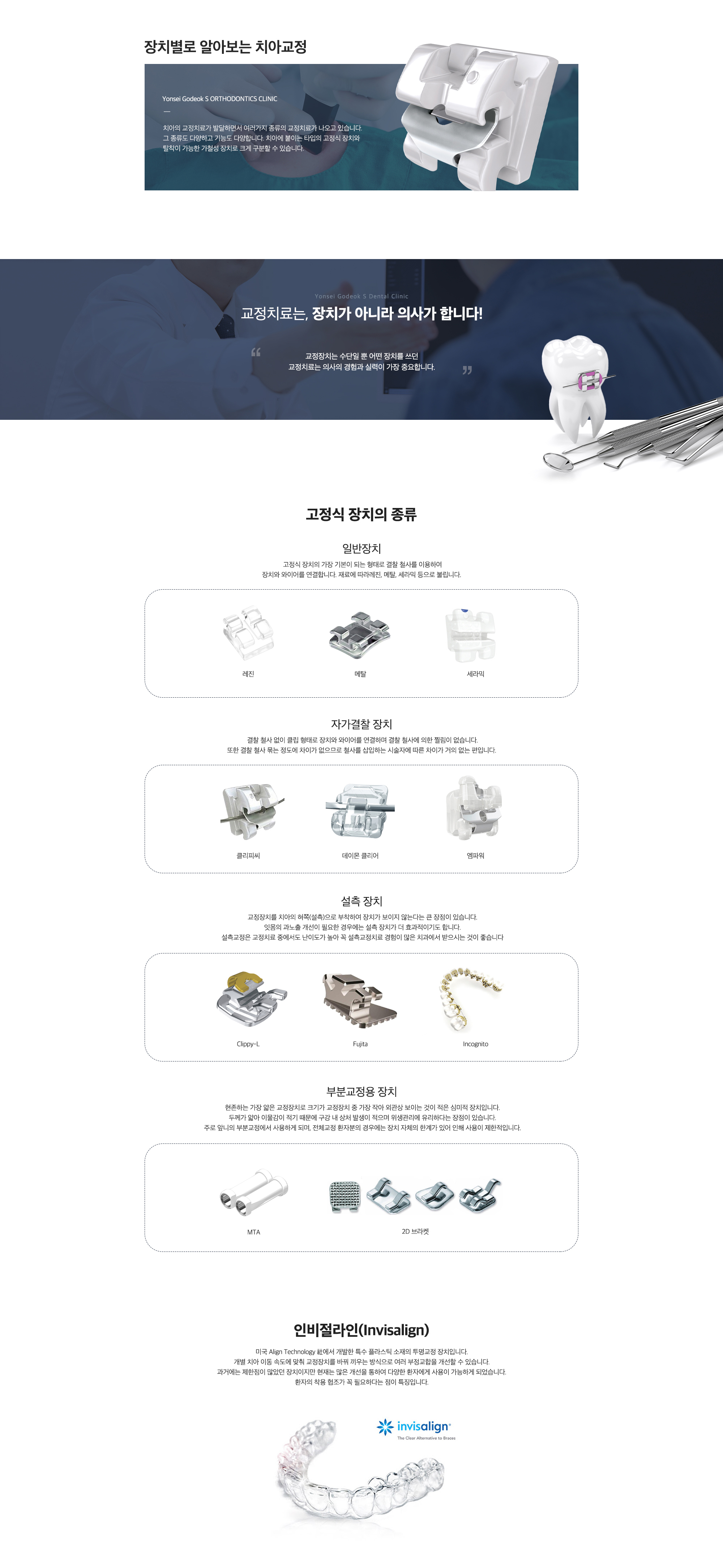
As orthodontic treatment has advanced, many different types of orthodontic appliances have become available. They vary widely in both form and function. Broadly, they can be divided into fixed appliances that are bonded to the teeth and removable appliances that can be taken in and out.
Orthodontic Treatment Is Done by the Doctor, Not the Appliance!
"The appliance is only a tool. Whichever appliance is used, what matters most in orthodontic treatment is the doctor's experience and skill."
Types of Fixed Appliances
Conventional Brackets
The most basic form of fixed appliance, in which ligature wires are used to connect the brackets to the archwire. Depending on the material, they are called resin, metal, or ceramic brackets.
- Resin
- Metal
- Ceramic
Self-Ligating Brackets
Instead of ligature wires, a built-in clip connects the bracket to the archwire, so there is no poking or irritation from ligature wires. And because there is no variation in how tightly ligature wires are tied, results vary very little from one practitioner to another when placing the wire.
- Clippy-C
- Damon Clear
- Empower
Lingual Appliances
Lingual appliances are bonded to the tongue-facing (lingual) side of the teeth, so they have the major advantage of being invisible. In cases where excessive gum exposure needs to be improved, lingual appliances can also be more effective. Lingual orthodontics is among the most technically demanding forms of orthodontic treatment, so it is best to receive it at a dental clinic with extensive experience in lingual treatment.
- Clippy-L
- Fujita
- Incognito
Appliances for Partial (Limited) Orthodontics
These are the thinnest orthodontic appliances available today. Being the smallest of all orthodontic appliances, they are highly esthetic and barely visible. Because they are so thin, they cause little discomfort, produce fewer sores inside the mouth, and are easier to keep clean. They are mainly used for partial orthodontic treatment of the front teeth; for patients needing full orthodontic treatment, their use is limited due to the inherent constraints of the appliance itself.
- MTA
- 2D Brackets
Invisalign
Invisalign is a clear-aligner system made of a special plastic material, developed by Align Technology of the United States. By switching to a new aligner matched to the movement pace of each individual tooth, it can correct a variety of malocclusions. While the system once had many limitations, numerous improvements now make it suitable for a wide range of patients. Its distinctive feature is that it requires the patient's consistent cooperation in wearing the aligners.